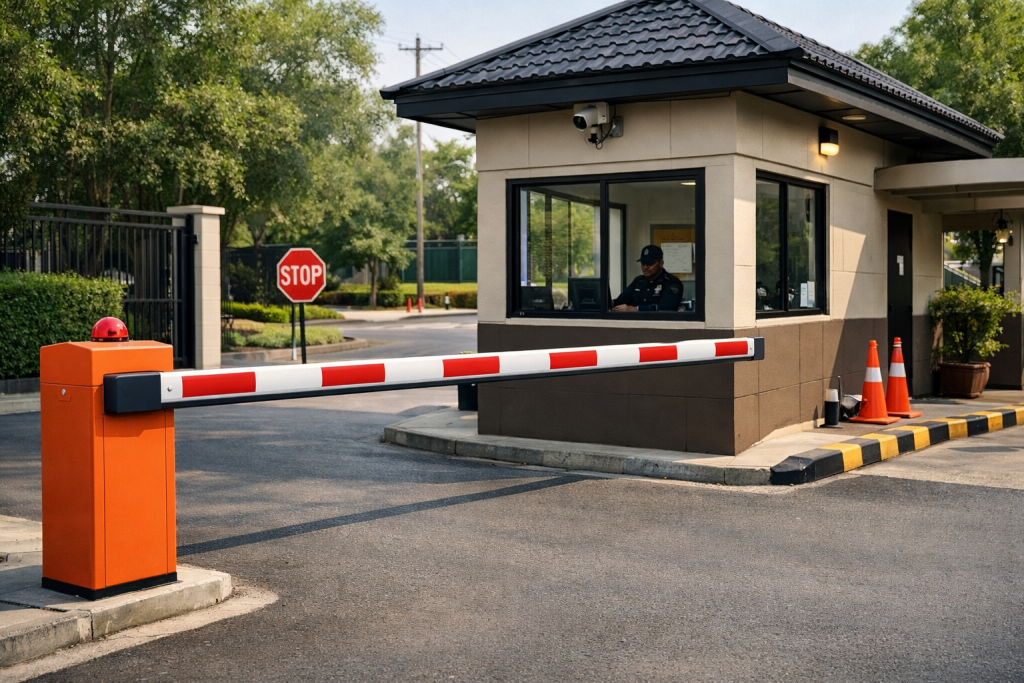
A Guard House Barrier Gate is the physical and psychological frontline of any secured facility. When positioned directly adjacent to a manned guard house, this system creates a controlled checkpoint where no vehicle enters without explicit permission.
Integrating a barrier gate with a guard house transforms a simple entrance into a hardened, verifiable checkpoint. Whether for a corporate campus, gated community, or industrial site, the combination of human oversight and mechanical stopping power begins with this essential equipment.
What Is A Guard House Barrier Gate?

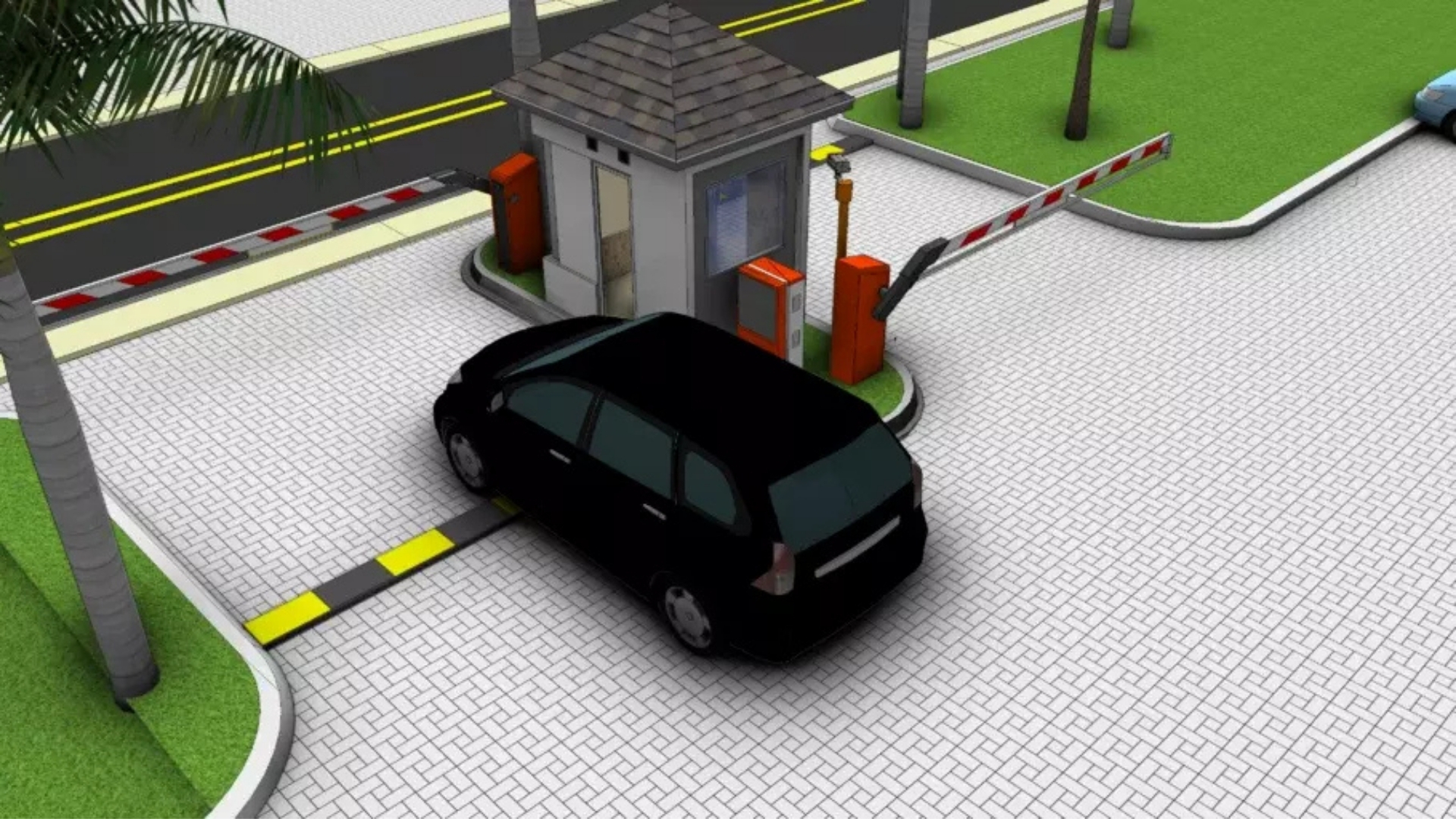
A Guard House Barrier Gate is a lifting boom arm system installed at the entrance and exit lane of a guard house. It is designed to be operated electronically that rely on RFID or license plate recognition system.
The core components include:
- The Boom Arm: Typically 3 to 6 meters long, painted with reflective red and white stripes for visibility.
- The Motor Housing: A weatherproof cabinet containing the gearbox and motor, usually bolted to a concrete island.
- Control Interface: A push-button panel, remote control, or software terminal located inside the guard house.
- Safety Sensors: Optional loop detectors or photoelectric beams to prevent the arm from closing on a vehicle.
In essence, the guard house provides the command center, while the barrier gate acts as the physical restraint. Neither is fully effective without the other.
Why It Matters In 2026?
Entering 2026, perimeter security has had to adapt to new threats. Vehicle ramming attacks, unauthorized convoy entry, and social engineering attempts have all increased. A simple sign or cone is no longer sufficient.
Here is why the Guard House Barrier Gate matters more than ever:
- Stops Tailgating: A guard visually confirms one vehicle, one clearance. The gate resets after each pass.
- Provides Dwell Time: The few seconds the vehicle waits at the barrier gives the guard time to inspect the driver, passenger, and vehicle condition.
- Acts as a Psychological Deterrent: A visible barrier, combined with a uniformed officer in a booth, discourages casual rule-breaking and hostile reconnaissance.
- Integrates with Modern Tech: Even in 2026, these systems work alongside AI cameras and ANPR without losing the human override capability.
Without this setup, facilities rely on either pure automation (which can be spoofed) or pure manpower (which is inconsistent). The guard house barrier gate bridges that gap.
How Does It Work?
The operation is straightforward, and relies on a simple request-verify-release cycle:
- Detection: A vehicle approaches and triggers a sensor, such as an underground magnetic loop detector or an infrared beam.
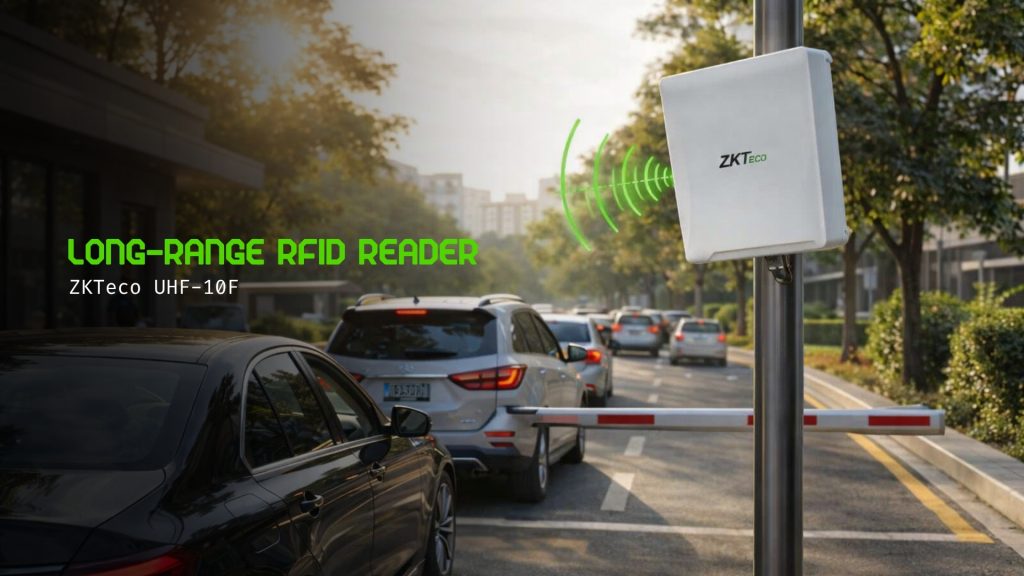
- Authorization: The system verifies access via methods like RFID tags, ANPR (license plate recognition), or remote controls.
- Opening: Once authorized, the control unit signals the motor to lift the arm, often in as little as 1.2 seconds.
- Closing: After the vehicle passes, sensors confirm the path is clear, and the arm automatically lowers back into position.
This closed-loop process ensures that no vehicle enters unless explicitly authorized at that moment.
Key Advantages Of Having A Guard House Barrier Gate
Compared to standalone barriers or unmanned bollards, this configuration offers distinct benefits:
| Advantage | Explanation |
|---|---|
| Enhanced Situational Awareness | The guard has a direct line of sight to the vehicle, driver, and potential threats inside the car – something cameras can miss. |
| Immediate Manual Override | No software bug or network lag prevents the guard from raising the gate instantly. |
| Weather Protection for Electronics | The sensitive control unit stays inside the heated/cooled guard house, not exposed on the barrier post. |
| Lower False Alarm Handling | If a vehicle stops too close or a sensor fails, the guard simply presses a button instead of troubleshooting a system. |
| Dual-Purpose Staffing | The same guard handling the barrier can also log visitors, answer calls, or monitor CCTV – no extra personnel needed. |
| Cost-Effective Retrofitting | You can add a barrier gate to an existing guard house for under $3,000–5,000 USD, far cheaper than full automation. |
The bottom line: You get the reliability of a human checkpoint with the physical enforcement of a steel-and-motor barrier.
Application Scenarios
Not every entrance needs a Guard House Barrier Gate. But for the following scenarios, it is the ideal solution:
1. Gated Residential Communities
- Why: Residents expect security but also convenience. A guard at a barrier can wave through known residents while stopping delivery trucks, ride-share vehicles, or tailgaters.
- Setup: Lane-specific barrier with intercom for visitors.
2. Corporate Campuses with Unmarked Visitor Traffic
- Why: Many visitors arrive without prior appointments. The guard verifies the host, logs the plate, and opens the barrier – all within 20 seconds.
- Setup: Barrier gate + visitor management tablet inside guard house.
3. Industrial Logistics Yards & Depots
- Why: Trucks entering must be weighed, documented, and directed. The barrier forces a full stop at the guard house window.
- Setup: Heavy-duty 5–6m boom arm with manual crank backup.
4. Government & Military Checkpoints
- Why: Authentication is non-negotiable. The guard visually matches IDs and physically controls entry with a barrier that cannot be digitally hacked.
- Setup: Reinforced barrier arm, bullet-resistant guard house, dual control buttons (manager override).
5. Event Parking & Stadiums
- Why: During large events, traffic flow must be strictly metered. A guard with a barrier can release vehicles in batches or verify VIP passes.
- Setup: Portable or temporary barrier gate with a pop-up guard tent.
Barrier Gate Installation
If you’re looking for a Professional Barrier Gate Installation, it starts with choosing the barrier gate first.
We are specialize in providing and installing barrier gate systems across Peninsular Malaysia and East Malaysia. We will help you find the right solution for your building. Whether it is a corporate office, shopping mall, airport, or transit hub.
Conclusion
As we move through 2026 the Guard House Barrier Gate remains not only relevant but essential. Contact us today for a free consultation. Let us show you how the right barrier gate system can secure your property, simplify your life, and give you one less thing to worry about.
Frequently Asked Questions (FAQ)
1. How fast can an automatic barrier gate open?
Speed varies by model and application:
- Standard parking gate: 1.5 to 3 seconds
- High-speed toll gate: 0.6 to 1.5 seconds
- Industrial heavy-duty gate: 3 to 6 seconds (for longer, heavier arms)
Faster gates use more powerful motors and are more expensive. For most parking lots, a 2-second opening time is perfectly adequate and balances cost with performance.
2. Can an automatic barrier gate work without electricity?
No. Unlike a manual gate, an automatic barrier gate requires electricity to power the motor and control board.
However, most units include a manual release mechanism (a crank handle or key release) that allows a person to lift the boom arm by hand during a power outage. For critical sites, a battery backup (UPS) can be added to provide 50–200 cycles when mains power fails.
3. Can an automatic barrier gate be integrated with access control systems?
Absolutely. Most modern barrier gates support integration with:
- RFID card readers (employee badges)
- License plate recognition (ANPR/ALPR) cameras
- QR code scanners (visitor passes)
- Intercom systems (visitor calls guard)
- Parking management software (pay stations, ticketing)
- Remote cloud control (open gate from a smartphone)
Integration is typically done via relay outputs (dry contacts) from the access controller to the gate’s open/close terminals.
4. What safety features prevent the gate from hitting a car or person?
Automatic barrier gates include several safety mechanisms:
- Obstacle detection: The motor detects abnormal resistance and automatically reverses or stops.
- Photoelectric sensors: A light beam across the lane triggers if an object is present.
- Rubber safety edge: A soft strip on the boom’s leading edge that acts as a bumper.
- Flashing lights & audible alarm: Warn pedestrians and drivers that the arm is moving.
- Manual release handle: Allows someone to lift the arm if the automatic system fails.
For public or high-foot-traffic areas, photoelectric sensors are highly recommended.
5. What is the lifespan of an automatic barrier gate?
With proper maintenance, a quality automatic barrier gate lasts 5 to 10 years or 500,000 to 2 million cycles (open-close operations). Key factors affecting lifespan:
- Duty cycle: Heavy traffic areas wear out motors faster.
- Weather exposure: Rust, UV damage, and freezing temperatures reduce longevity.
- Maintenance schedule: Lubrication, belt checks, and loop detector testing extend life.
We at LockPro Technology SDN BHD offers professional services on smart access technology. Our team consist of passionate and dedicated staffs that have more than 7-year experience as smart lock and door access control installer.
As a smart lock and access control installer, we provide a variety of safe locks and access control. Both for business and also for home usage. We supply the best smart lock and access control in the market, coming from high quality brand such HIKVISION, SAMSUNG. ZKTECO and VLOCK. Hit us up to unlock your door without a key today!