

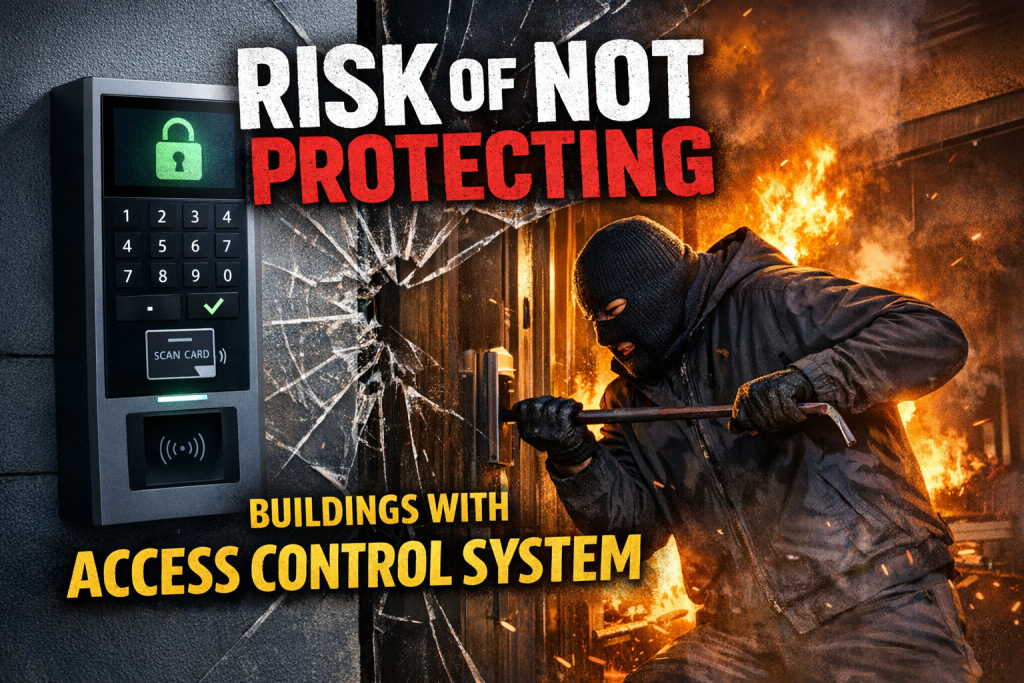
The risk of not protecting buildings with access control system technology will lead to sensitive data vulnerable to theft, vandalism, and legal liability. With the modern threat landscape ranging from unauthorized intrusions to insider threats—demands a smarter, more dynamic security approach. In this article, we will guide you on how to protect your buildings with access control system.

An access control system is an electronic security solution that manages and monitors who can enter or exit specific areas of a building at specific times. Unlike traditional mechanical keys, which can be easily copied, lost, or stolen, ACS uses credentials such as keycards, biometrics (fingerprints, facial recognition), mobile apps, or PIN codes to grant or deny entry.

Access control is critical for buildings of all types. For example; commercial offices, residential complexes, educational institutions, healthcare facilities, and industrial sites. Here’s why it matters:
Failing to deploy an access control system exposes a building to a wide spectrum of preventable threats. These risks are not merely theoretical; they manifest daily in businesses and properties that rely on outdated or nonexistent entry management. Below are the most critical risks.
Without an electronic system, any lost, stolen, or copied mechanical key becomes a permanent backdoor. Former employees, disgruntled contractors, or even strangers who found a dropped key can enter the building at any hour—often without leaving a trace. This leads directly to theft of equipment, inventory, sensitive documents, and even IT hardware containing proprietary data.
Traditional locks leave no record of who came and went. When a security incident occurs—say, vandalism overnight or a missing file from a locked office—management has no forensic evidence to investigate. Was it a janitor? A night shift employee? An outsider? Without an access log, you are left guessing. This lack of accountability also cripples internal investigations for policy violations or harassment claims.
The greatest risk to many buildings comes from within. Employees, tenants, or regular visitors with keys or shared codes can abuse access without detection. For example, a staff member working after hours might let an unauthorized friend into a server room, or a cleaning crew might enter executive offices to steal confidential records. An access control system would flag unusual after-hours entry attempts; without it, these insider actions remain invisible.
The absence of ACS creates logistical nightmares. When an employee loses a key, the building owner faces a costly choice: rekey entire sections (paying a locksmith and distributing new keys to everyone) or do nothing and accept the security gap. Multiply this by dozens of doors and hundreds of users, and you waste hours of administrative time tracking keys, managing duplicates, and responding to lockouts. Worse, no system exists to grant temporary access to a delivery driver or a weekend repair crew without handing over a physical key.
During a fire, active shooter event, or medical emergency, an uncontrolled building creates chaos. Without ACS, security personnel cannot quickly lock down sections to contain a threat or remotely unlock emergency exits to speed evacuation. In some systems, automated lockdowns or unlocks require electronic control—something impossible with mechanical keys. This delay can cost lives.
Implementing ACS offers tangible benefits over traditional lock-and-key methods:
Choosing the right system depends on building size, budget, and specific needs. Below are three highly rated solutions suitable for different scenarios:


Tip: Always consult a certified security integrator to assess your building’s door hardware (e.g., electric strikes, magnetic locks) before purchasing a system.
The risk of not protecting buildings with access control system can caused the possibilities from injured employees, regulatory fines for data breaches, and sky-high insurance premiums. In contrast, a well-designed access control system provides layered, auditable, and flexible protection that scales with your building’s needs.
If you’re looking for the installation for the best access control system for your building, look no further than Lockpro Technology. We also provide installation for access control brands such as Hikvision, ZKTeco, VLOCK and many more.
Contact us today for a free consultation. Secure your property, simplify your life, and give you one less thing to worry about.