Understanding RFID Card Types And Compatibility For Access Control
Choosing the right access control system for your office, apartment building, or home involves more than just picking a smart lock or a card reader. One of the most overlooked aspects is the RFID card types that is designed for each access control.
If you have ever tried to tap your office badge on a gym reader only to have it fail, you have experienced an RFID compatibility issue firsthand. Not all RFID cards are created equal.
In this guide, we will break down the different RFID card types, the frequencies that matter, and how to ensure compatibility with your existing or future access control system.
What Is RFID Technology?
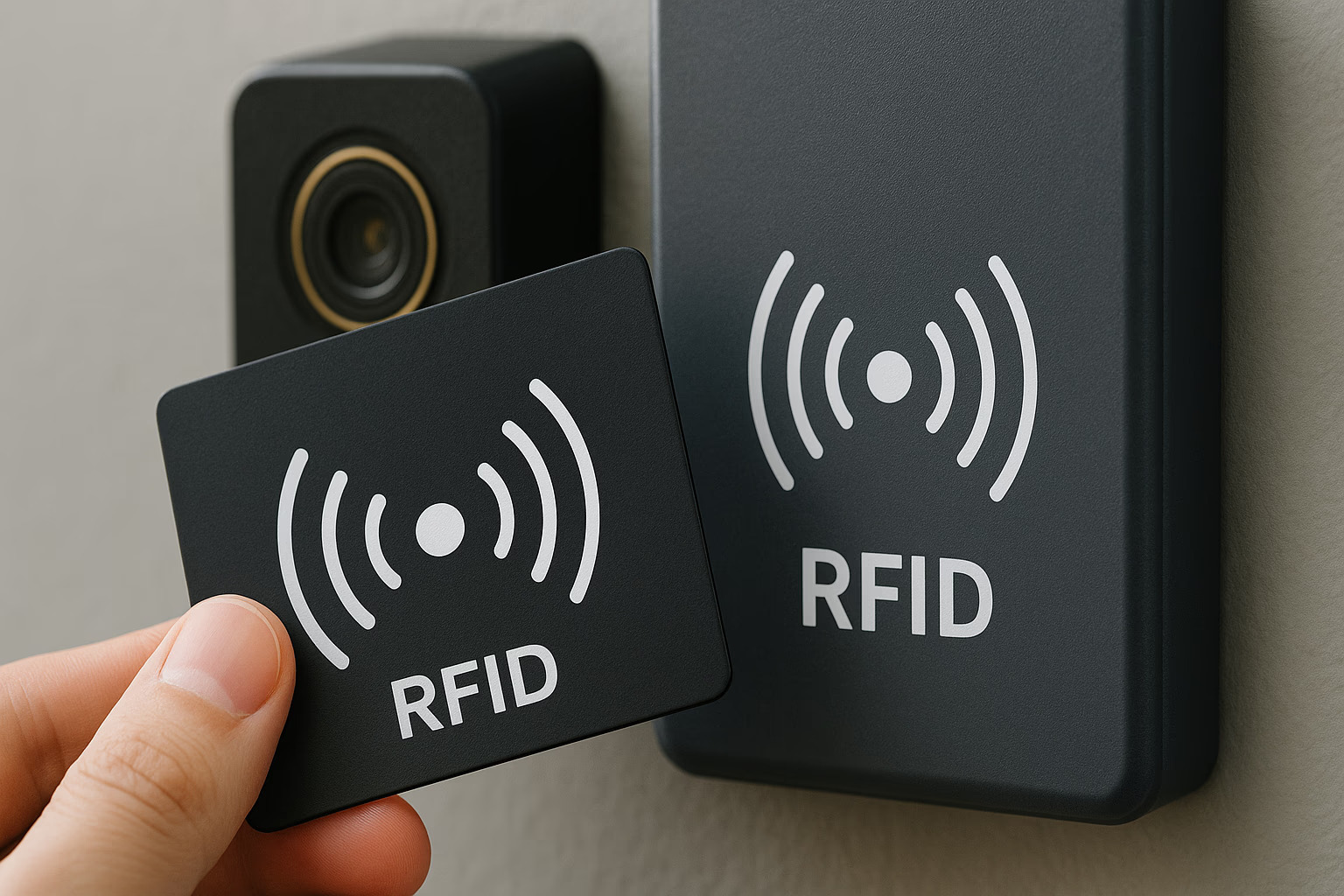
RFID stands for Radio Frequency Identification. In the world of security, it is the technology that allows a card or fob to communicate with a reader without physical contact. Simply waving the card near the reader sends a unique credential to the lock, granting or denying access.
However, the “language” spoken between the card and the reader depends on two main factors: frequency and protocol.
The 3 Main RFID Frequency Types
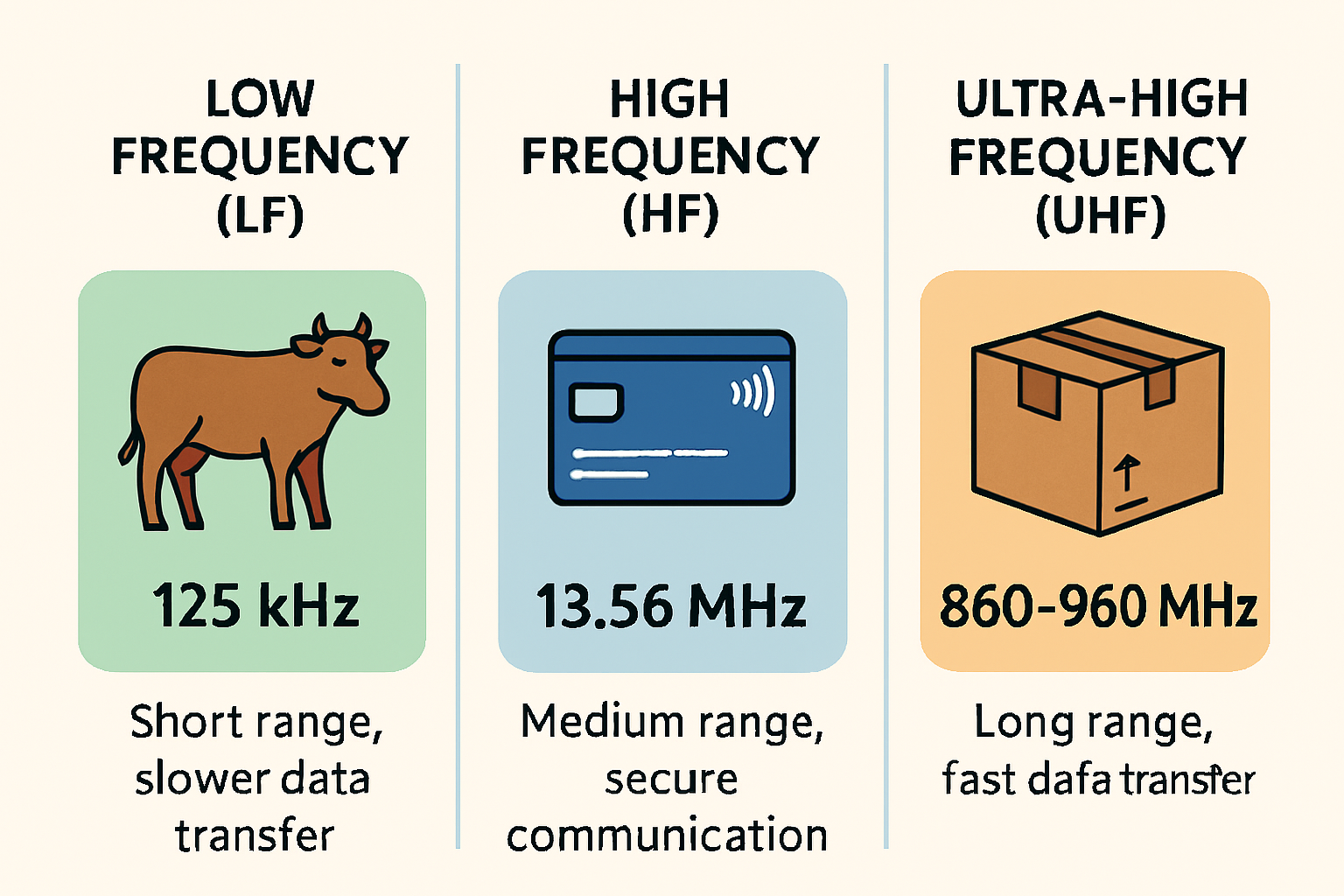
When discussing RFID card types, the most important distinction is the frequency they operate on. Think of this like different radio stations—a 125 kHz radio cannot pick up a 13.56 MHz station.
1. Low Frequency (LF) – 125 kHz
This is the oldest and most common technology for basic proximity access.
Common Names: Proximity cards, Prox cards, HID Prox, EM4102.
Read Range: Very short (2–10 cm).
Pros: Highly resistant to interference from metals or liquids, cheap to produce, works on battery-powered readers for a long time.
Cons:Low security. These cards are typically “read-only.” They broadcast a static ID number that can be easily copied or cloned with readily available hardware. Data storage is minimal.
Best For: Garage doors, internal office doors where security risk is low, or upgrading old key-turn locks.
2. High Frequency (HF) – 13.56 MHz
This is the current standard for modern access control systems. If you have a hotel key card or a modern office badge, it is likely HF.
Common Names: MIFARE (Classic, Plus, DESFire), NFC, HID iCLASS, LEGIC.
Read Range: Short to medium (up to 10 cm).
Pros:Better security. Supports encryption and mutual authentication (the reader verifies the card, and the card verifies the reader). It also allows for read/write capabilities, meaning you can update the card (e.g., add balance for a cafeteria) without issuing a new one.
Cons: Slightly more expensive than LF, and the read range can be affected by metal (which is why phone NFC readers are often placed away from metal cases).
Best For: Front doors, hotel rooms, office buildings, universities, and any area requiring higher security.
3. Ultra-High Frequency (UHF) – 860-960 MHz
This is less common for standard door access but is growing in popularity for vehicle access or large corporate campuses.
Common Names: RAIN RFID, EPC Gen2.
Read Range: Long (up to 10+ meters).
Pros: Can read cards from a long distance and can read multiple cards at once.
Cons: Expensive readers, and signals can be disrupted by liquids and metals.
Best For: Parking garage entry, supply chain management, or walk-through employee check-in.
Common RFID Card Technologies
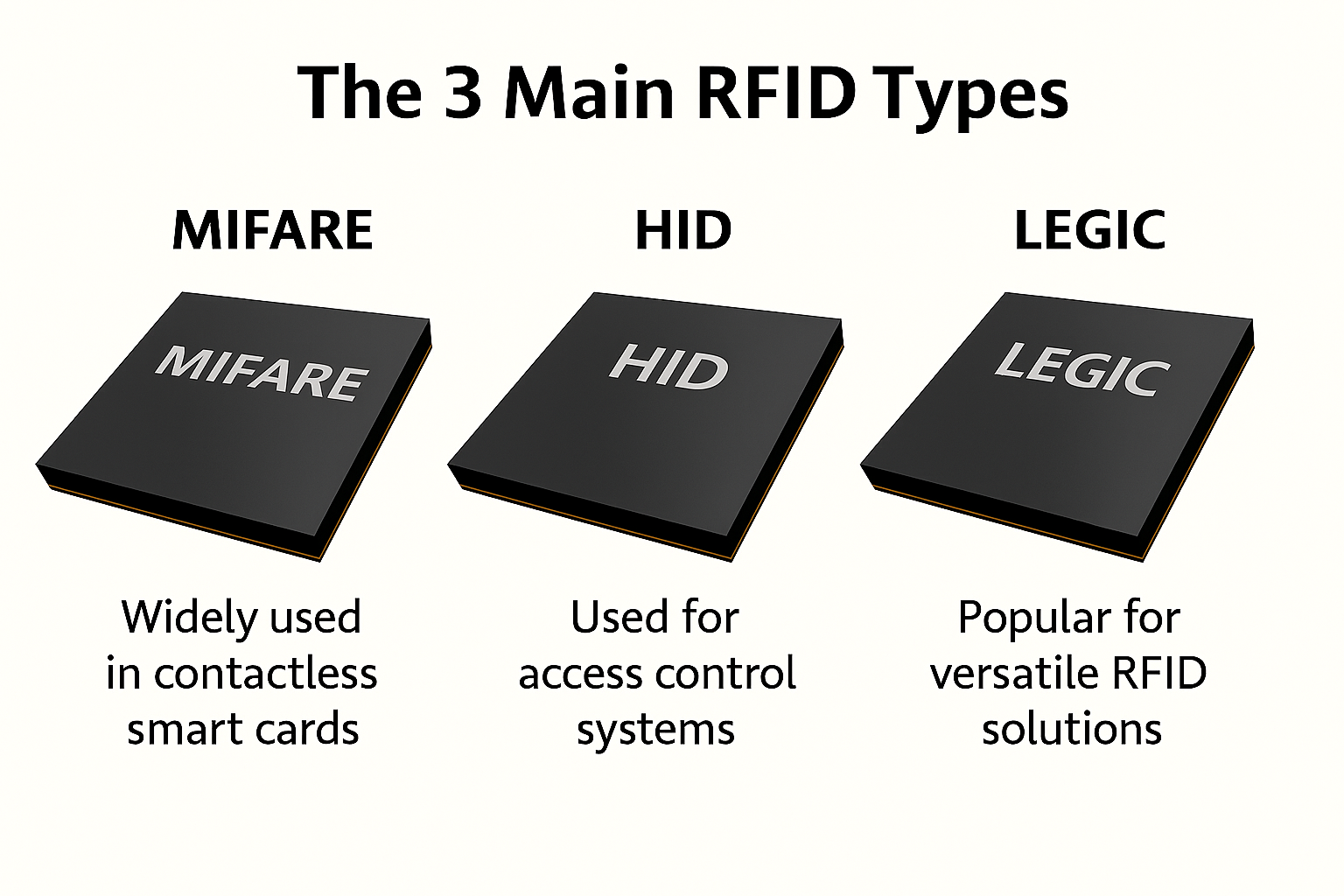
To further complicate compatibility, even cards on the same frequency (like 13.56 MHz) can use different encryption protocols. Here are the major players you need to know:
MIFARE (The Industry Standard)
Owned by NXP Semiconductors, MIFARE is the dominant brand for 13.56 MHz access control.
MIFARE Classic: The most widespread. Used in transport and access. Note: The encryption on the original Classic has been cracked, but it is still widely used for low-stakes access.
MIFARE DESFire: The high-security version. Used by banks and government buildings. It is compliant with global encryption standards and is considered future-proof.
HID (The U.S. Access Giant)
HID Global is massive in the Americas. They produce both 125 kHz and 13.56 MHz cards.
HID Prox: Their famous 125 kHz line.
HID iCLASS: Their 13.56 MHz line, which is directly comparable to MIFARE.
LEGIC (The European Standard)
Very popular in Europe and parts of Asia. LEGIC readers are often “multi-standard,” meaning they can read multiple card types, which is a huge advantage for compatibility.
Why Compatibility Matters
Imagine you spend thousands installing a new access control system, only to find out your employees’ old 125 kHz badges won’t work with your new 13.56 MHz readers.
Here is the golden rule: The card and the reader must speak the exact same language (Frequency + Protocol).
A 125 kHz HID Prox card will not work on a 13.56 MHz MIFARE reader.
A MIFARE Classic card may not work on a reader set up to only read MIFARE DESFire (though many readers are backwards compatible).
How To Avoid Compatibility Headaches
Check Your Existing Hardware: Look at the reader on your wall. Is there a logo? (HID, MIFARE, ASSA ABLOY?). This tells you what card you need.
Look for Multi-Technology Readers: If you are buying a new system, purchase readers that can handle both 125 kHz and 13.56 MHz. This allows for a gradual migration to newer, more secure cards.
Consult a Professional: If you are managing a large building, ask your security integrator for a “card compatibility report.”
Conclusion
RFID card for access control is essential because it serves as the very key to your digital and physical security.
Choosing the wrong type of RFID Card Types For Access Control can lead to significant vulnerabilities, unexpected costs, and operational headaches.
By choosing trusted access control system brands like ZKTeco, Hikvision or VLOCK Malaysia, will ensuring a reliable and effective ecosystem. Thus, it will serve you flawlessly for years to come.
Looking For The Best Door Access Control Installation
Contact us today (Lockpro Technology Sdn Bhd) for professional Door Access Control installation. Reach us to learn more about Access Control System and how we can support your building needs.
We at LockPro Technology SDN BHD offers professional services on smart access technology. Our team consist of passionate and dedicated staffs that have more than 7-year experience as smart lock and door access control installer.
As a smart lock and access control installer, we provide a variety of safe locks and access control. Both for business and also for home usage. We supply the best smart lock and access control in the market, coming from high quality brand such HIKVISION, SAMSUNG. ZKTECO and VLOCK. Hit us up to unlock your door without a key today!